
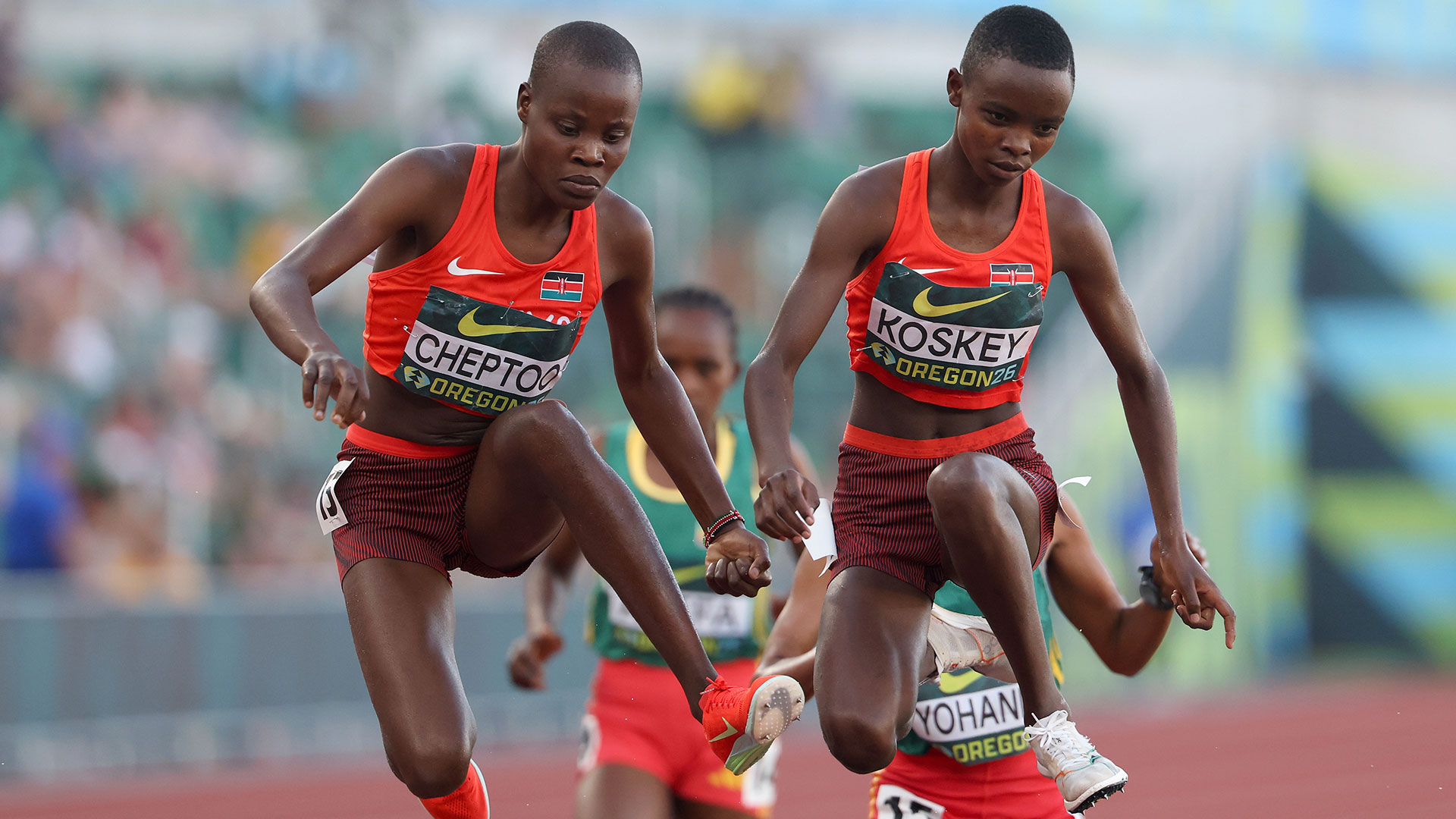
Kenya’s 11 medals at the 2026 World Athletics U20 Championships came from only four disciplines: the 1,500m, 3,000m, 5,000m and 3,000m steeplechase.
There were four gold medals, three silver and four bronze. Every medal came in a race of at least 1,500m. For a championship offering dozens of events, Kenya worked within a very small patch of track.
It worked rather well.
Wilson Chepkwech won the men’s 1,500m in 3:37.46, with David Kapaiko Sekento taking silver in a personal best of 3:38.32. Josephine Sembeyo Mancha won the women’s title in 4:16.73 and Caren Chepchirchir took bronze in 4:17.50.
Frankline Kibet led a Kenyan one-two in the men’s 5,000m, winning in 13:28.27 ahead of Nehemiah Kipngeno, who ran 13:30.09. Joyline Chepkemoi added bronze in the women’s race with a personal best of 15:09.08.
Emmanuel Kiprono supplied the other gold, running 7:28.28 in the men’s 3,000m. It was a championship record. Emmanuel Lemiso Someki and Nicholas Kitum Losiwareng collected silver and bronze in the men’s 3,000m steeplechase, while Anatasha Cheptoo won bronze in the women’s event.
Four disciplines, 11 medals. Oregon did not broaden Kenya’s World U20 record. It gave a particularly clear view of it.
Eleven is close to the Kenyan average
The championships began in Athens in 1986. Counting each relay medal once for the team and applying current official result status, Kenya has won 229 medals in 21 editions: 96 gold, 76 silver and 57 bronze.
That works out at 10.9 medals per edition. Oregon’s 11 was therefore almost exactly an average Kenyan performance, although seven editions have produced a larger total.
The highest haul is 16, reached in Eugene in 2014 and Nairobi in 2021. Kenya won 15 medals in 2006 and 2010, and 14 in 2000. The seven medals won in 2004 and 2024 remain the lowest totals. Oregon added four medals to the Lima total, but it did not approach the peaks.
| Edition | Gold | Silver | Bronze | Total |
|---|---|---|---|---|
| 1986 | 4 | 4 | 0 | 8 |
| 1988 | 6 | 2 | 2 | 10 |
| 1990 | 4 | 2 | 2 | 8 |
| 1992 | 3 | 4 | 2 | 9 |
| 1994 | 3 | 4 | 3 | 10 |
| 1996 | 3 | 5 | 1 | 9 |
| 1998 | 3 | 7 | 3 | 13 |
| 2000 | 7 | 4 | 3 | 14 |
| 2002 | 5 | 1 | 2 | 8 |
| 2004 | 4 | 2 | 1 | 7 |
| 2006 | 6 | 7 | 2 | 15 |
| 2008 | 4 | 5 | 2 | 11 |
| 2010 | 7 | 4 | 4 | 15 |
| 2012 | 4 | 4 | 5 | 13 |
| 2014 | 4 | 5 | 7 | 16 |
| 2016 | 4 | 2 | 2 | 8 |
| 2018 | 6 | 4 | 1 | 11 |
| 2021 | 8 | 1 | 7 | 16 |
| 2022 | 4 | 3 | 3 | 10 |
| 2024 | 3 | 3 | 1 | 7 |
| 2026 | 4 | 3 | 4 | 11 |
| Total | 96 | 76 | 57 | 229 |
Across the first four decades, the average rose from 9.0 medals per edition in the 1980s to 9.8 in the 1990s, 11.0 in the 2000s and 12.6 in the 2010s. The four championships held in the 2020s have produced an average of 11.0.
This is not a smooth rise. Junior teams change quickly, and one outstanding group can alter a medal table in five days. The 40-year record is useful because it removes some of that noise.
Six events account for 221 medals
The steeplechase stands alone. Kenyan athletes have won 53 medals in the event across the 2,000m and 3,000m formats used over the years. Twenty-six were gold, and Kenya has won at least one steeplechase medal at every edition since 1986.
No other discipline has survived all 21 championships without a blank year.
The 1,500m is next with 44 medals, including 20 gold. Kenya medalled in the event at 20 of the 21 editions, missing only in 2024. The 5,000m has supplied 38 medals, the 800m 35, the 10,000m 28 and the 3,000m 23.
Together, those six disciplines account for 221 of Kenya’s 229 medals, or 96.5 per cent of the total.
The concentration is even clearer in Oregon. Kenya won four 1,500m medals, three in the steeplechase, three in the 5,000m and one in the 3,000m. The 800m, historically Kenya’s fourth most productive event, yielded no medal despite two Kenyan men reaching the final.
Kenya is exceptionally strong at the World U20 Championships, but it is not strong everywhere. The evidence describes a highly productive endurance programme, not a complete athletics programme.
The junior track leads somewhere
Results at under-20 level do not guarantee a senior career. Some junior champions disappear from international competition. Others improve slowly and reach their best years later. Even so, Kenya’s World U20 record has repeatedly introduced athletes who would return on the largest stage.
Names also require care. A junior result may use an athlete’s longer name while an Olympic record uses the shorter public form. After resolving four clear variants of this kind, a conservative cross-check finds at least 49 athletes who appear in both Kenya’s World U20 results and Kenya’s Summer Olympic records.
Nineteen of them won Olympic medals. Ten became Olympic champions. Between them, the 19 collected 28 Olympic medals.
Peter Rono won World Junior 1,500m silver at the inaugural championships in 1986 and Olympic gold two years later in Seoul. Noah Ngeny appeared at the 1996 junior championships before winning the same Olympic title at Sydney 2000. Reuben Kosgei won the world junior steeplechase title in 1998, while Wilfred Bungei took 800m silver at that edition. Both later became Olympic champions.
The later generations are just as persuasive. David Rudisha won the world junior 800m title in 2006 before taking Olympic gold in 2012 and 2016. Faith Kipyegon won the world U20 1,500m title in 2012 and has since won three Olympic titles at the distance. Beatrice Chebet, the 2018 world U20 5,000m champion, won the Olympic 5,000m and 10,000m titles in Paris. Emmanuel Wanyonyi went from world U20 800m champion in Nairobi in 2021 to Olympic champion three years later.
That Kenyan Olympic count does not cover every international path. Wilson Kipketer represented Kenya at the 1988 and 1990 junior championships, later competed for Denmark and won three senior world 800m titles and two Olympic medals. After retirement, he served as an IAAF ambassador and worked with young athletes.
Janeth Jepkosgei offers another version of the transition. She won the world U20 800m title in 2002, became a senior world champion and Olympic silver medallist, and later moved into coaching and mentoring. By 2024, she was head coach of the U20 Athlete Refugee Team.
For Kenya, the championships have been a recurring point of entry into senior international athletics, coaching and other roles in the sport. They are not a promise of what comes next, but they have often provided a first public look at it.
At a glance
Kenya's Six Leading World U20 Disciplines, 1986-2026
These six events account for 221 of Kenya's 229 medals.
Steeplechase
- Medals
- 53
- Gold
- 26
1,500m
- Medals
- 44
- Gold
- 20
5,000m
- Medals
- 38
- Gold
- 12
800m
- Medals
- 35
- Gold
- 17
10,000m
- Medals
- 28
- Gold
- 9
3,000m
- Medals
- 23
- Gold
- 10
Steeplechase combines the 2,000m and 3,000m formats. Relay medals are counted once per team.
The women’s team has grown faster than the medal share
Across 21 editions, 471 Kenyan athlete-edition entries are identifiable when each athlete is counted once at each championship. Women account for 194, or 41.2 per cent, and men for 277.
The early teams were much more uneven. Only three of Kenya’s 17 athletes in 1988 were women. In 1990, the split was five women and 15 men. The first even entry came in 2004, with 10 women and 10 men.
The last six editions show the change more clearly. From 2016 to 2026, women made 78 of 169 Kenyan entries, or 46.2 per cent. The official Oregon results list 23 Kenyan competitors: 11 women and 12 men.
The medal record has not caught up. Women have won 85 of the 229 medals, or 37.1 per cent, while men have won 144. Women have out-medalled the men at only two editions: 8-7 in 2006 and 6-4 in 2022. Oregon produced four women’s medals and seven men’s medals.
Near-parity in entry numbers matters because it widens the pool from which future champions can emerge. The results still show that representation does not automatically produce an equal share of medals.
The missing side of the programme
Only eight Kenyan medals in 40 years have come from outside the six leading disciplines. Three were in the 20km road race, two in the 400m, one in the 400m hurdles, one in the 10,000m race walk and one in the 4 × 400m relay.
Kenya has never won a World U20 medal in the 100m or 200m. It has never won one in a field event.
Oregon at least included one Kenyan field-event appearance. Kelvin Kipngeno Bii contested the men’s triple jump qualification but did not record a valid mark. Kenya’s sole 100m entrant did not advance from the first round. Neither result changed the medal pattern.
The issue is not the result of one championship or the work of one young athlete. Four decades of results point to a programme whose recruitment, coaching depth and competitive pathway remain concentrated in the middle- and long-distance events.
Data note
Medal totals count one medal for a relay team rather than one for each runner, and reflect official result status as at 11 August 2026. The 2016 total excludes a men’s 10,000m result that World Athletics now records as disqualified. Steeplechase totals combine the 2,000m and 3,000m versions contested during the championships’ history.
The Nairobi 2021 total comes from the underlying official event results and World Athletics’ report published at the end of the championships. Both produce 8 gold, 1 silver and 7 bronze. The current World Athletics medal-table display shows an additional Kenyan silver, but no second silver appears in the event results and no later reallocation was identified.
Entry figures count an athlete once per edition, irrespective of the number of rounds or events contested. The Olympic crossover is a conservative minimum based on direct matches and four independently resolved longer-name variants.
The concentration has produced 229 medals, a steeplechase medal at all 21 editions and at least 19 future Olympic medallists. It is plainly a strength.
It is also the limit shown by the figures. Kenya’s World U20 record reads 53 steeplechase medals and no field-event medals. Oregon kept both parts of that record intact.